ICSE Class 10 Circles (Tangent and Cyclic Properties) — Mock Test (2027)
Free online mock test for Circles (Tangent and Cyclic Properties) (ICSE Class 10 Mathematics) — 20 competency-based questions based on the latest CISCE 2027 syllabus, with instant marking. Try the samples below, then take the full test free.
What to expect: This mock test covers key concepts from the Circles (Tangent and Cyclic Properties) chapter — including application-based and competency-focused questions aligned with how ICSE actually sets the paper.
Tip: Attempt without notes first to identify gaps, then review explanations for any wrong answers. Retake after a few days for best retention.
Sample questions
-
1.In the figure given below, P and Q are the centres of two circles intersecting at B and C. ACD is a straight line. The angle marked x is labelled at point P. What does x represent in the diagram?
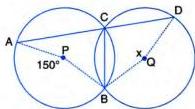
- A.The measure of ∠BPC, the angle subtended by chord BC at centre P
- B.The measure of ∠BQC, the angle subtended by chord BC at centre Q
- C.The exterior angle formed by the intersection of the two circles at point C
- D.The reflex angle at point P formed by the line segment PC and the tangent at C
-
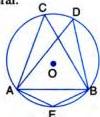
2.In the given diagram, ∠CAB = 75° and ∠CBA = 50°. Which of the following correctly represents the value of ∠DAB + ∠ABD?
- A.55°
- B.105°
- C.125°
- D.130°
-
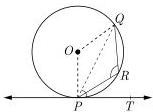
3.In the given figure, $PQR$ is a right-angled triangle with $PQ = 3$ cm and $QR = 4$ cm. A circle is inscribed in the triangle, touching all its sides. What is the radius of the circle?
- A.0.5 cm
- B.1 cm
- C.2 cm
- D.3 cm
-
4.In the given figure,
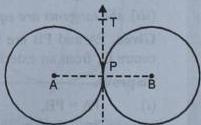 , quadrilateral ABCD is circumscribed and AD ⊥ AB. If the radius of the incircle is 10 cm, which labelled segment corresponds to the value of x?
- A.The side AB
- B.The side BC
- C.The side CD
- D.The side AD
-
5.Given: ∠CAB = 75° and ∠CBA = 50°. Find the value of ∠DAB + ∠ABD.
Ready? Take the full 20-question test free — instant marking, no sign-up needed.
▶ Start free mock test