ICSE Class 10 Reflection — Mock Test (2027)
Free online mock test for Reflection (ICSE Class 10 Mathematics) — 20 competency-based questions based on the latest CISCE 2027 syllabus, with instant marking. Try the samples below, then take the full test free.
What to expect: This mock test covers key concepts from the Reflection chapter — including application-based and competency-focused questions aligned with how ICSE actually sets the paper.
Tip: Attempt without notes first to identify gaps, then review explanations for any wrong answers. Retake after a few days for best retention.
Sample questions
-
1.A point lies on the y-axis at a distance of 5 units from the x-axis. What are the coordinates of this point?
- A.(5, 0)
- B.(0, 5)
- C.(5, 5)
- D.(0, -5)
-
2.Point A(1, -5) is reflected in the x-axis to obtain A', and point B(3, 2) is reflected in the origin to obtain B'. What are the coordinates of A' and B', and what is the distance AB'?
- A.A' = (1, 5), B' = (-3, -2), AB' = √65 units
- B.A' = (-1, 5), B' = (3, -2), AB' = √60 units
- C.A' = (1, -5), B' = (-3, 2), AB' = √68 units
- D.A' = (1, 5), B' = (-3, 2), AB' = √65 units
-
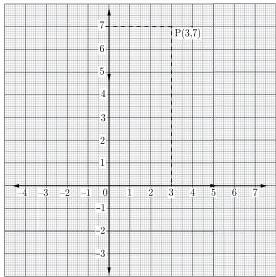
3.Use the graph paper for this question. Points A(1,1), B(5,1), C(4,2) and D(2,2) are the vertices of quadrilateral ABCD. After reflecting A, B, C, and D in the origin to obtain A', B', C', and D', which of the following statements is true regarding the points D, A, A', and D'?
- A.The quadrilateral ABCD is a parallelogram, and D, A, A', D' are collinear.
- B.The quadrilateral ABCD is an isosceles trapezium, and D, A, A', D' are collinear.
- C.The quadrilateral ABCD is a rhombus, and D, A, A', D' are not collinear.
- D.The quadrilateral ABCD is a rectangle, and D, A, A', D' form a square.
-
4.Assertion (A): The reflection of the point $P(-2, 7)$ in the $y$-axis is $(2, -7)$. Reason (R): When a point is reflected in $y$-axis, only the sign of $x$-coordinate changes. (a) Both assertion (A) and reason (R) are true and reason (R) is the correct explanation of assertion (A). (b) Both assertion (A) and reason (R) are true but reason (R) is not the correct explanation of assertion (A). (c) Assertion (A) is true but reason (R) is false. (d) Assertion (A) is false but reason (R) is true.
- A.Both assertion (A) and reason (R) are true and reason (R) is the correct explanation of assertion (A).
- B.Both assertion (A) and reason (R) are true but reason (R) is not the correct explanation of assertion (A).
- C.Assertion (A) is true but reason (R) is false.
- D.Assertion (A) is false but reason (R) is true.
-
5.Use the graph paper for this question. Points A(1,1), B(5,1), C(4,2) and D(2,2) are the vertices of a quadrilateral ABCD. What is the name of quadrilateral ABCD? If A, B, C and D are reflected in the origin onto A', B', C' and D' respectively, what are the coordinates of A'?
- A.(-1, 1)
- B.(1, -1)
- C.(-1, -1)
- D.(0, 0)
Ready? Take the full 20-question test free — instant marking, no sign-up needed.
▶ Start free mock test