ICSE Class 10 Chemical Bonding — Mock Test (2027)
Free online mock test for Chemical Bonding (ICSE Class 10 Chemistry) — 20 competency-based questions based on the latest CISCE 2027 syllabus, with instant marking. Try the samples below, then take the full test free.
What to expect: This mock test covers key concepts from the Chemical Bonding chapter — including application-based and competency-focused questions aligned with how ICSE actually sets the paper.
Tip: Attempt without notes first to identify gaps, then review explanations for any wrong answers. Retake after a few days for best retention.
Sample questions
-
1.The total number of double and triple bonds in the structure, $(CN)_2C = C(CN)_2$ are
- a.1
- b.5
- c.9
- d.Unpredictable
-
2.What is the basic tendency of an atom that makes it combine with other atoms?
- A.To lose or gain protons to achieve a stable nucleus.
- B.To attain a stable electronic configuration, typically that of the nearest noble gas.
- C.To increase its atomic mass by sharing neutrons with other atoms.
- D.To reduce its energy by expelling all valence electrons.
-
3.(b) Select the right answer — (i) Sodium chloride — covalent bond / ionic bond / covalent and coordinate bond. (ii) Ammonium ion — covalent bond / ionic bond / covalent and coordinate bond. (iii) Carbon tetrachloride — covalent bond / ionic bond / covalent and coordinate bond.
-
4.In the electron dot diagram of a hydronium ion (H₃O⁺), where is the lone pair of electrons located?
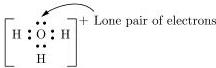
- A.On one of the hydrogen atoms
- B.On the oxygen atom
- C.Between oxygen and hydrogen atoms
- D.There is no lone pair in H₃O⁺
-
5.Which of the following sets of conditions correctly describes the formation of an electrovalent bond?
- A.One atom must have high ionization energy, the other must have low electron affinity, and the ions must repel each other.
- B.One atom must easily lose electrons, the other must easily gain electrons, and the resulting ions must have stable electronic configurations with strong electrostatic attraction.
- C.Both atoms must have high ionization energy and low electron affinity, forming shared electron pairs.
- D.The atoms must have identical electronegativities and form neutral molecules without charge separation.
Ready? Take the full 20-question test free — instant marking, no sign-up needed.
▶ Start free mock test